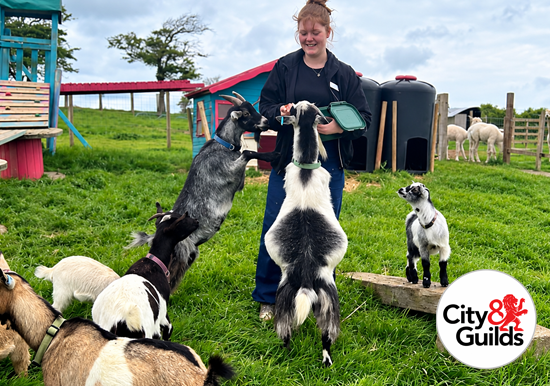
Our City & Guilds Level 3 Subsidiary Diploma in Animal Management is a nationally recognised, 60-credit vocational qualification combining advanced animal care knowledge with practical farm management, investigative work and land-based skills.
Over two academic years, learners attend one day per week at the farm, alternating manageable periods of theory with practical activities. Independent research, written assignments and structured home study form an important part of the programme.
Year 1 covers animal health, accommodation, feeding and behaviour, with the opportunity to achieve the 30-credit Level 3 Certificate. Year 2 extends learning through an investigative project, estate skills and farm livestock husbandry.
The programme welcomes suitable learners progressing from Level 2 and new applicants with the readiness for Level 3 study. The usual recommended age is 16+; any younger applicant is subject to City & Guilds eligibility rules and an individual suitability assessment.
The Level 3 Subsidiary Diploma in Animal Management is a 60-credit qualification designed to develop advanced knowledge, practical competence and independent working skills across animal management and the wider land-based sector.
Teaching combines real farm activities, supervised observations, classroom discussions, research and written assignments. The two-year structure provides time to develop confidence and progress from familiar animal care subjects to more independent projects and broader practical work.
Year 1: Units 301, 302, 304 and 310 (30 credits). Learners may achieve the Level 3 Certificate in Animal Management at the end of this stage, subject to meeting all qualification requirements.
Year 2: Units 308, 330 and 331 (30 further credits). Learners develop project, estate maintenance and livestock husbandry skills towards the 60-credit Subsidiary Diploma.
Learners who wish to deepen their understanding of animal management through practical and academic study, including those progressing from Level 2 Animal Care and suitable new learners without a previous animal care qualification.
Home-educated learners and young people who benefit from a structured, practical learning environment may also find the course suitable, provided they are ready to meet the Level 3 requirements.
This course is primarily designed for learners aged 16 and above. Younger learners may be considered only if City & Guilds registration rules permit and the centre confirms their individual suitability.
Previous animal care qualifications are not essential. Completion of Level 2 Animal Care or strong GCSE English grades may help demonstrate readiness, but neither guarantees entry or overrides awarding organisation requirements.
Applicants should be prepared for independent research, self-study, written assignments and practical assessments. Our initial assessment considers academic readiness, animal experience, safe working, maturity and individual support needs.
Successful learners may consider further vocational study, specialist animal care training, work experience or appropriate employment pathways, depending on the entry requirements of their next programme.
The Subsidiary Diploma is planned as seven units across two years, providing a balance of animal science, practical management, independent investigation and land-based skills.
Study animal health, disease prevention, biosecurity and health management. Apply knowledge through observations, monitoring and supervised animal health activities.
Investigate species-specific accommodation requirements, environmental conditions and welfare. Assess housing and consider appropriate maintenance and improvements.
Develop and evaluate feeding plans, examine feed choices and monitor feeding arrangements through records and practical observations.
Explore animal behaviour, communication and factors influencing welfare. Collect, interpret and evaluate behavioural observations.
Plan and carry out an individual investigation relevant to the land-based sector. Learners research a topic, gather and analyse evidence, present findings and evaluate their project.
Develop safe, practical skills in maintaining boundaries, structures, surfaces and habitats. Activities may include appropriate lightweight repairs, pathway maintenance and habitat work, with individual adjustments considered where permitted.
Build knowledge and practical competence in livestock husbandry, including welfare, handling, health, accommodation and routine management. Learning can draw on suitable supervised activities with farm livestock.
Farm activities are linked to Level 3 learning outcomes and supported by self-study, research, written work, analysis and reflection. Practical tasks and assessment evidence will follow the current City & Guilds requirements.
Our planned group programme is one day per week over two academic years, supported by structured independent study at home. The exact timetable and availability will be confirmed before enrolment.
Farm days combine tutor-led teaching with practical husbandry, animal observations, investigations and estate skills. Shorter periods of theory are interspersed with hands-on learning.
Individual or hybrid arrangements may be considered subject to availability, suitability and City & Guilds assessment requirements. Practical competence must still be demonstrated in an appropriate setting.
Learners should plan for approximately three hours of independent study each week, including Moodle activities, research, assignment preparation and written work. Project work in Year 2 may require additional planning at certain times.
Assessment takes place throughout both years and may include practical tasks, tutor observations, written assignments, project reports, research and portfolio evidence, in accordance with the current City & Guilds assessment pack.
Unit 308 includes an independent investigative project. Units 330 and 331 include practical skills that learners must demonstrate safely. Tutors provide teaching and feedback, and consider permitted reasonable adjustments, but each learner must meet the required assessment criteria.
Achievement of the Certificate after Year 1 and the Subsidiary Diploma after Year 2 is subject to completion of the required units and awarding organisation rules.
Fees depend on the learning centre, delivery option and level of individual support required. Fees for each academic year, payment arrangements and any City & Guilds registration or certification charges will be confirmed before enrolment.
Parents and carers can enquire about privately funded places, subject to availability and individual course suitability.
Places may be commissioned by schools, local authorities or other educational organisations, including appropriate alternative provision or EOTAS arrangements. Funding must be agreed with the commissioning organisation.
Contact the relevant learning centre to discuss availability, fees and payment arrangements.
After successfully completing the Level 3 Subsidiary Diploma in Animal Management, learners may consider:

Explore further animal management or specialist vocational qualifications, subject to entry requirements.

Consider appropriate animal care, livestock, volunteering and work experience opportunities.
Progression depends on each learner's achievements and the entry requirements of the next opportunity.

Practical Education Beyond the Classroom
Providing practical, farm-based education, recognised qualifications and alternative learning opportunities at Frampton Farm in Kent and Poppies Farm in Berkshire, helping young people develop confidence, independence and skills for the future.
Access course materials, complete theory activities and keep up with your learning using Moodle.
Download the Moodle app for your phone or tablet.