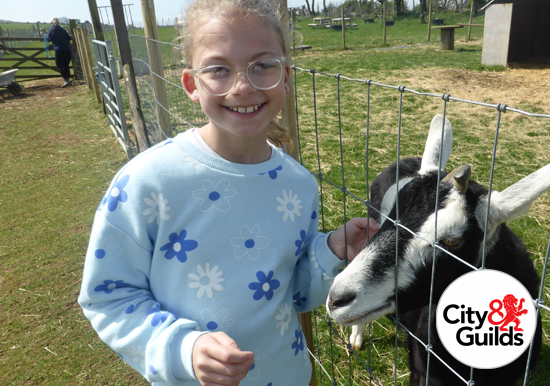
Develop practical farm animal care skills alongside ICT, independent project work and enterprise activities. This City & Guilds qualification combines meaningful hands-on experience with supportive classroom learning and assessment.
Designed with younger learners in mind, typically ages 11 years +, the course helps build confidence, responsibility, communication and practical skills in a real working farm environment.
Our Entry Level 3 Certificate in Skills for Working Life – Land Based (Animals) offers a practical introduction to caring for livestock, poultry and small animals, while developing skills for learning and working life.
Learners complete ten selected units totalling 23 credits, with opportunities to learn through supervised farm activities, ICT tasks, an individual project and an enterprise activity.
Young people interested in animals and farm life, including home-educated learners and those who benefit from practical, structured learning.
Learners ready to work towards Entry Level 3 outcomes with appropriate guidance, including those progressing from Entry Level 2.
No previous qualifications are required. We generally recommend the programme for ages 11 years + although suitability is considered individually. Learners must be able to participate safely and meet the qualification's assessment criteria with permitted support.
Successful learners may progress to suitable Level 1 land-based or work-based animal care qualifications, or further vocational learning, depending on age and individual readiness.
Our chosen programme combines three preparing-for-work units (9 credits) with seven practical animal-related units (14 credits).
Unit 306 – Candidate Project (3 credits): Plan, carry out and review an individual project, such as an animal enrichment idea or a farm improvement activity.
Unit 310 – Enterprise Activity (3 credits): Plan, promote, undertake and review a suitable small enterprise activity, such as growing plants or creating farm-related products.
Unit 313 – Introduction to ICT (3 credits): Develop computer skills, search for information, use software and present information safely and effectively.
Unit 325 – Recognise a Healthy Farm Animal (2 credits): Observe and identify signs of health, inspect suitable livestock and report concerns.
Unit 326 – Move and Prepare Farm Animal Pens (2 credits): Help dismantle, move and prepare suitable animal pens, including bedding, water and shelter.
Unit 327 – Clean Farm Animal Housing (2 credits): Clean and prepare animal accommodation, following hygiene and safety procedures.
Unit 328 – Weigh Farm Animals (2 credits): Prepare weighing equipment, assist with moving suitable animals, record weights and clean equipment.
Unit 329 – Feed Young Farm Animals (2 credits): Prepare and provide milk substitute to a suitable young farm animal, following safe feeding procedures. This unit is seasonal and depends on appropriate animals being available.
Unit 331 – Poultry Housing and Bedding (2 credits): Recognise suitable poultry accommodation, bedding and important housing features.
Unit 343 – Groom a Small Animal (2 credits): Select appropriate grooming equipment and carry out a supervised grooming activity.
Practical sessions are supported by short teaching activities, discussion, ICT work and portfolio tasks. All activities and assessments are planned around animal welfare, safe working and the individual learner's abilities.
Attend one farm day per week, usually 9am–3pm, over one academic year. Sessions combine short classroom activities with practical husbandry, ICT, projects and enterprise learning.
Individual sessions may be arranged to meet a learner's needs and pace. Attendance and duration are agreed according to the learning and assessment requirements, subject to availability.
Hybrid delivery combines tutor-guided remote learning for suitable theory, ICT and project activities with essential practical sessions and assessments at the farm. A supervised timetable will be agreed individually; home self-study alone does not replace required guided learning or practical competence.
Assessment is through a portfolio of evidence, including practical observations, assessor records, learner work, project plans, enterprise evidence, ICT tasks and suitable photographs or recordings.
Practical skills are assessed in a realistic working environment. Learners must meet all required criteria; appropriate access arrangements and reasonable adjustments can be considered without changing assessment standards.
The qualification is graded Pass or Fail, with assessment completed throughout the programme rather than through one final examination.
After completing the Entry Level 3 Certificate, suitable progression opportunities may include:

Build on farm-based learning through safe working and livestock care.
Click to read more

Develop wider livestock knowledge and practical land-based skills.
Click to read more

Gain introductory work-based experience in animal care, accommodation and handling.
Click to read more
Progress towards a broader practical animal care qualification.
Click to read more
Progression depends on each learner's achievements, abilities, interests and readiness for the next level.

Practical Education Beyond the Classroom
Providing practical, farm-based education, recognised qualifications and alternative learning opportunities at Frampton Farm in Kent and Poppies Farm in Berkshire, helping young people develop confidence, independence and skills for the future.
Access course materials, complete theory activities and keep up with your learning using Moodle.
Download the Moodle app for your phone or tablet.


Fees & Funding
Course Fees
Fees vary by learning centre and delivery option. Small-group, individual and hybrid arrangements are subject to availability, with fees and payment terms confirmed before enrolment.
City & Guilds registration and certification charges may apply.
Privately Funded Places
Parents and carers can enquire directly about a place, subject to suitability and availability.
School & Local Authority Funding
Schools and local authorities may commission suitable vocational placements, including alternative provision or agreed EOTAS arrangements. Funding must be agreed with the commissioning organisation.
Enquire About Fees
Contact your preferred learning centre for current availability, delivery arrangements and costs.