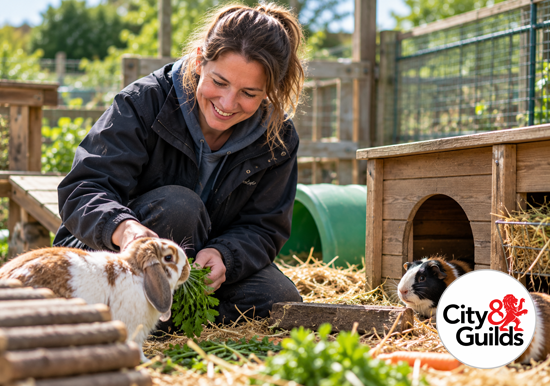
Develop the knowledge and practical skills needed to care for small mammals responsibly, from suitable housing and feeding to welfare checks, routine husbandry and safe handling.
Suitable for smallholders, aspiring small mammal keepers and learners seeking a focused, recognised animal-care qualification. Theory is linked to practical small mammal husbandry, with an individual practical assessment and oral questions.
This specialist City & Guilds Level 2 Certificate develops essential small mammal health, husbandry and handling skills. The qualification is assessed in the small mammal context and the certificate is endorsed Exotic Pets – Small Mammals (certification module 908).
Adults who keep or plan to keep small mammals, learners interested in companion animal care, and those wishing to add specialist practical competence to other animal-care studies.
For learners aged 16+. No particular prior qualification is stated, but learners must be able to meet the assessment requirements and work safely and compassionately with small mammals. Individual suitability, support needs and practical access are discussed before enrolment.
Continue with other species-endorsed specialist certificates, broader Level 2 animal-care learning or suitable Level 3 animal management study.
All teaching and assessment relate specifically to small mammals. The five learning outcomes cover:
Understand suitable small mammal accommodation, including suitable hutches or enclosures, shelter, ventilation, bedding, environmental enrichment and maintenance. Practise appropriate cleaning, checking for damage and safe waste disposal.
Provide suitable feed and clean water using appropriate feeding equipment and methods. A written feed plan is not required by this learning outcome.
Explore small mammal social behaviour, body language and how social needs influence appropriate social housing and management.
Learn safe approaches to moving and handling rabbits, guinea pigs or other suitable small mammals with suitable species-appropriate handling techniques and equipment, selecting appropriate protective equipment, carrying out basic health checks and recognising concerns, alongside appropriate preventative care and parasite-control awareness.
Consider the five animal welfare needs and the responsibilities involved in keeping small mammals, including difficult welfare decisions.
Teaching examples and practical opportunities will depend on small mammal welfare, safe access and the animals available at the chosen centre.
Small group: three-hour weekly sessions combining tutor-led learning with supervised practical small mammal care activities.
One-to-one: three-hour weekly personalised sessions, subject to availability.
Hybrid: theory activities can be completed remotely with tutor guidance, alongside scheduled in-person practical teaching and assessment. The qualification cannot be completed entirely online.
The qualification specifies 14 guided learning hours and 16 total qualification hours. At three hours per week, the programme is expected to take approximately five to six sessions, with additional time arranged where necessary for learning, assessment or individual support. Actual duration is agreed before enrolment.
City & Guilds requires a one-to-one practical assessment with oral questioning. The qualification is graded Pass only. All learners, including those studying in a group or by hybrid delivery, must demonstrate their own practical competence.
Assessment is planned with small mammal welfare and safety as priorities. Approved access arrangements may be available where appropriate.
Course fees depend on the learning option, centre, practical arrangements and any additional individual support required. Please contact us for a quotation, including City & Guilds registration and assessment charges.
We welcome enquiries from adults, smallholders and families seeking specialist small mammal husbandry training.
Suitable places may be commissioned where the course forms part of an agreed vocational or alternative education programme.
Contact Frampton Farm in Kent or Poppies Farm in Berkshire to discuss availability, suitability and assessment arrangements.
Develop further specialist skills through additional certificates or broader animal care qualifications.

Explore separate species-endorsed certificates in cattle, sheep, pigs, goats, poultry and other animal groups.

Broaden animal welfare, health and husbandry knowledge through a larger vocational programme.

Consider further animal management study when ready for higher-level knowledge and responsibility.

Practical Education Beyond the Classroom
Providing practical, farm-based education, recognised qualifications and alternative learning opportunities at Frampton Farm in Kent and Poppies Farm in Berkshire, helping young people develop confidence, independence and skills for the future.
Access course materials, complete theory activities and keep up with your learning using Moodle.
Download the Moodle app for your phone or tablet.